
Nut Sort: Color Sorting Game
Tripledot Studios LimitedPuzzle
4.89.37K Reviews
- Version
- 1.32.1
- Installs
- 10.00M
- Age Rating
- Everyone
Screenshots
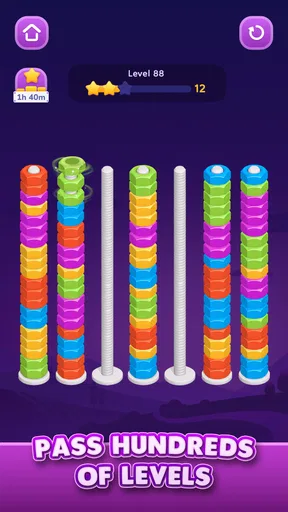
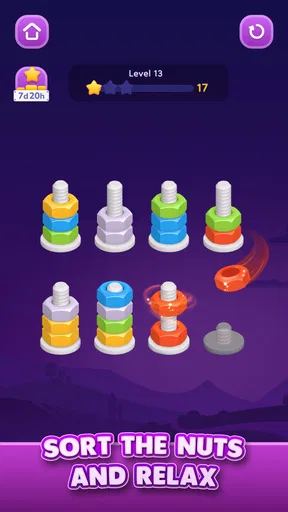
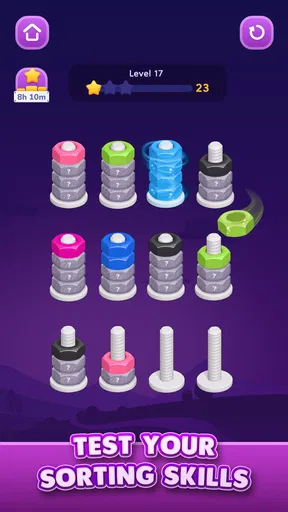
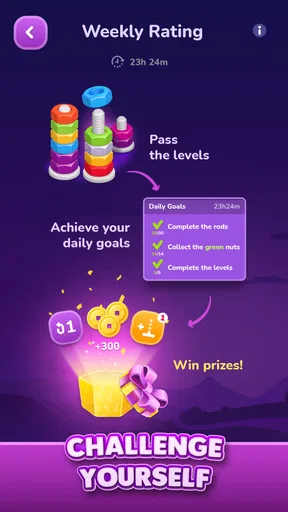
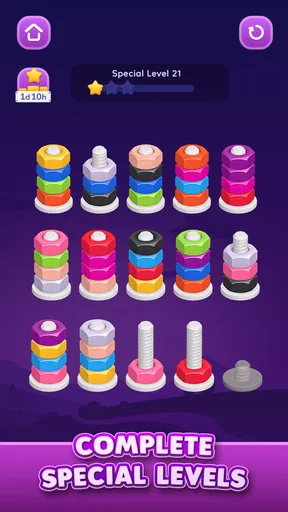


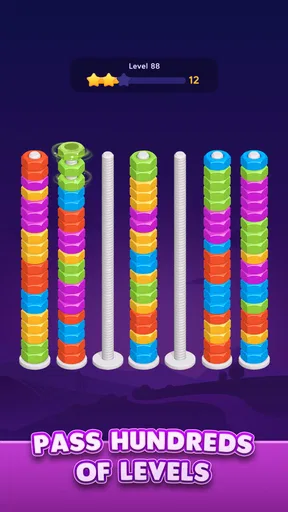
Our Review of Nut Sort: Color Sorting Game
 Analysis by Appyee
I picked up Nut Sort: Color Sorting Game expecting a simple way to pass a few spare minutes, and that is exactly where it works best. The idea is easy to understand: colored nuts sit on bolts, and I move them until each bolt contains one color. It is a puzzle game from Tripledot Studios Limited, free to download, with an Everyone age rating. After spending time with it, I found a calm, tactile experience that rewards planning without demanding a long session.
What makes it worth considering is not a complicated premise, but the way a small sorting problem can become surprisingly absorbing. I can begin with one level while waiting for a coffee and still feel that satisfying urge to solve just one more. At the same time, the simplicity also creates its main weakness: players looking for story, dramatic progression, or deep strategic variety may find the format repetitive. My recommendation depends heavily on whether you want a focused sorting challenge rather than a broad game.
How the current version feels to play
The basic interaction is immediately approachable. I tap a nut stack, then choose where to place it, watching the available space and the colors hidden underneath. The goal is not simply to match visible pieces. I have to think about which move exposes a useful color, which bolt should remain open, and whether I am about to trap a stack behind an inconvenient arrangement.
That combination gives the game more thought than its bright, uncomplicated presentation suggests. A move that looks helpful in the moment can remove the only free space I needed later. I quickly learned to pause before tapping, especially when several bolts had partially completed colors. The best decisions often involve delaying an obvious match so I can uncover a better sequence first.
The current release is version 1.32.1, and the product has been available since February 6, 2024. Those details matter mainly because this is not a brand-new experiment with an uncertain identity. It has had time to settle into a recognizable puzzle format, while the version number shows that the developer has continued working on the app rather than leaving the initial release untouched.
In everyday use, I would describe the pace as gentle but mentally active. There is no need to memorize a large rule set, and I do not need a long uninterrupted block of time. A short session can still feel complete because each puzzle has a clear beginning and end. For me, that makes it more practical than games that require a daily streak, a lengthy tutorial, or a constant internet of objectives competing for attention.
The visual language also serves the central mechanic well. Since color is the main information I use, the board needs to remain readable at a glance. I found myself focusing less on decoration and more on the order of the stacks, which is appropriate for this type of puzzle. The experience is strongest when the interface stays out of the way and lets the arrangement itself provide the challenge.
The small decisions that separate easy moves from good moves
My most useful habit was to treat empty bolts as planning resources, not just spare containers. It is tempting to fill an open space immediately, but keeping one area available can prevent a later dead end. Before making a move, I scan for colors buried beneath the top nuts and ask which stack will become accessible after the move. That simple pause improves the quality of play more than rushing toward the first matching option.
Another practical approach is to finish a color only when doing so does not block access to the colors underneath it. A completed bolt feels like progress, but it can also remove flexibility if the surrounding arrangement is still crowded. I usually prioritize opening space and revealing hidden pieces before committing to a final-looking move. This is the kind of lesson that becomes clear through play rather than through the short store summary.
I also found that the game suits a “one puzzle, then stop” routine better than a marathon for some players. When I played continuously, familiar patterns began to feel less fresh, and mistakes were more likely because I stopped examining the board carefully. Taking a break after a frustrating layout made the next attempt feel more deliberate. That makes it useful as a small mental reset, but less convincing as a main game for long evening sessions.
Who will enjoy it, and who should look elsewhere
I would recommend it to anyone who likes color matching, organizing tasks, and puzzles that can be understood without instructions. It is particularly suitable for short breaks, commuting, or those moments when I want something interactive but not emotionally intense. The Everyone rating also makes its presentation broadly accessible, although the right fit still depends on a player’s tolerance for repeated sorting challenges.
It may also work well for people who enjoy thinking spatially. The challenge is not only recognizing colors; it is managing limited room and predicting how a sequence of transfers changes the board. Players who like untangling arrangements or planning several steps ahead will probably get more from it than someone who only wants instant matching.
I would skip it if I need a narrative, character development, competitive multiplayer, or a strong sense of discovery between levels. It is also not my first choice when I want a traditional match-three game with quick chain reactions. Those alternatives usually provide more visual spectacle and faster feedback. Nut Sort is slower and more methodical, so its appeal comes from tidying a complicated board rather than creating a dramatic cascade.
Compared with classic block puzzles, this game feels less reflex-driven and more forgiving in pace. Compared with ordinary color-matching games, it asks me to think about storage space and order rather than simply connect similar items. That distinction is important: if I enjoy arranging objects but dislike timers and frantic tapping, this is a better match. If I prefer constant action, the deliberate pace could feel flat.
What the developer’s ongoing version history means in practice
Tripledot Studios Limited presents the game as an established puzzle product rather than a one-off novelty. The current version, 1.32.1, suggests ongoing maintenance and refinement, but I would not treat a version number alone as proof that every personal annoyance has been solved. It tells me that the app has evolved, not precisely which parts changed or how those changes affect every device.
For an existing player, the practical takeaway is to judge the current build on its present feel. If the core sorting loop already suits you, continued updates are a reason to keep the app installed. If you are hoping for a completely different type of game, a higher version number should not create that expectation. The central experience remains the arrangement of colored nuts and bolts, and that focused identity is both its strength and its limitation.
New players can approach the current release without needing to understand its earlier stages of development. I would simply begin with a few puzzles and pay attention to how much I enjoy planning around empty space. That test is more useful than assuming popularity guarantees a personal fit. The game has an average rating of 4.8 from around 682 thousand ratings, which indicates strong reception, but my own response still depends on whether sorting puzzles hold my attention.
The scale of its audience is also notable: it has passed 10 million installs, with roughly 9.4 thousand written reviews. That level of adoption makes it easier to see why the format has broad appeal, but it does not change the basic trade-off. A widely played puzzle can still feel too repetitive for someone who wants constant novelty, while a modest, focused game can be perfect for a person who enjoys routine.
Where the experience still has friction
The biggest limitation is repetition. Once I understand the logic of moving stacks and protecting free space, the presentation has to carry the experience through many similar decisions. That can be relaxing, but it can also make progress feel less meaningful if I am not personally motivated by solving arrangements for their own sake.
Another potential source of frustration is the cost of an early mistake. A careless tap can change the available space and force me to rethink several moves. I appreciate that this gives the puzzle consequences, but I do not always want a small lapse in attention to undo a promising setup. Players who prefer generous undo systems or completely consequence-free experimentation should pay attention to how comfortable they feel with the game’s move handling during their first sessions.
The free entry point is helpful, but in-app purchases range from $0.99 to $119.99 per item. I would treat that range as a reason to review purchase settings before handing the device to a child or allowing unrestricted buying. The game itself is free, yet “free to download” is not the same as “everything is free.” For me, that distinction is part of deciding whether it belongs on a shared family device.
I also would not choose it as a substitute for a dedicated brain-training program. Sorting colored objects can encourage planning and attention, but it is still a game built around one main mechanic. If I wanted varied exercises for memory, language, arithmetic, or reaction time, I would look for a broader app. This one is better when I want one polished type of challenge and do not mind returning to that same idea.
Practical advice before making it a regular game
When I play during a short break, I set a simple goal: solve a small number of boards carefully rather than measure the session by speed. That keeps the game relaxing and reduces the urge to make impulsive moves. If a layout becomes tangled, I mentally mark the bolt that must stay open and work backward from the colors I need to expose. This approach is more reliable than moving pieces merely because a matching destination is available.
For younger or less experienced players, I would demonstrate the idea of preserving space rather than only explaining “put the same colors together.” That single concept makes the puzzles easier to understand and helps avoid the common mistake of filling every available bolt too soon. Since the age rating is Everyone, the game is broadly approachable, but children may still need help understanding why a seemingly correct move can cause trouble several turns later.
On a phone with limited storage, the app’s free price makes trying it low-risk from a purchase perspective, though I would still consider whether I actually enjoy the repeated format before keeping it long term. On a tablet, the larger board could make color relationships easier to inspect, especially for players who find small stacks difficult to distinguish. I would not install it expecting a large content-heavy adventure; I would install it as a compact puzzle tool for spare moments.
One useful test is to notice what kind of frustration you feel. If a difficult board makes you curious about the correct sequence, the game is probably doing its job for you. If the same board only makes you want to tap through it or abandon the session, a faster matching game may be a better choice. That distinction matters more than the high rating because puzzle enjoyment is unusually personal.
What I would watch as the game continues
For future updates, I would be most interested in whether the developer keeps the core loop clear while adding enough freshness to prevent fatigue. New arrangements can extend the life of a sorting game, but variety needs to feel meaningful rather than simply making boards busier. I would also watch how the balance between challenge and recovery develops, because a puzzle is more satisfying when mistakes teach me something instead of only creating irritation.
I would pay attention to how comfortably the game serves both newcomers and experienced players. Beginners need readable layouts and a gentle learning curve, while regular players need reasons to return after the basic strategy becomes familiar. The strongest evolution would preserve the clean color-and-space logic that makes the game accessible without turning every later challenge into visual clutter.
My current view is that Nut Sort: Color Sorting Game succeeds as a focused, free puzzle for short sessions. It is easy to start, more thoughtful than the premise first suggests, and well suited to people who enjoy organizing a board one careful move at a time. Its limits are equally clear: the central mechanic can become repetitive, it does not replace a story-driven or action-oriented game, and optional purchases deserve sensible attention.
If I were recommending it to a friend, I would say this: try it when you want a quiet sorting challenge, not when you are searching for a complete entertainment package. Give the first puzzles your full attention, learn to protect empty space, and decide whether the satisfaction of uncovering the right sequence keeps pulling you back. For that specific use, it is a polished and approachable choice, and the current version gives the game a solid foundation without changing what makes it distinctive.
Verdict
Strengths of Nut Sort: Color Sorting Game
- Simple drag-and-drop controls are easy for players of all ages.
- Short levels make it convenient for quick breaks or casual play.
- Gradually increasing difficulty keeps the basic sorting mechanic engaging.
- Offline play is useful when traveling or using limited mobile data.
- Colorful visuals make the tubes and balls easy to distinguish.
Limitations of Nut Sort: Color Sorting Game
- Later puzzles can feel repetitive because the core mechanic rarely changes.
- Some levels may require trial and error rather than pure logical planning.
- Ads can interrupt gameplay, especially between completed levels.
- Small tubes and balls may be harder to manage on compact screens.
- The game offers limited variety beyond sorting colored balls.
Other Releases by Tripledot Studios Limited
View All
Woodoku - Wood Block Puzzle
Puzzle4.2

Get Color - Water Sort Puzzle
Puzzle4.8


Car Out! Traffic Parking Games
Puzzle4.7
Similar Picks in This Category
View All
Block Blast!
HungryStudio4.8

Braindom: Brain Games Test
Lahana Game Studio4.6

AMAZE!
CrazyLabs LTD4.6

Sudoku - Classic Sudoku Puzzle
Oakever Games4.7

Art Puzzle - Puzzle Games
Easybrain4.8

Amaze GO!
Oakever Games4.9
Frequently Asked Questions
What is Nut Sort: Color Sorting Game?
Nut Sort: Color Sorting Game is a casual puzzle game based on organizing colored nuts or bolts into matching containers. The main goal is to sort every piece by color, usually by moving one nut at a time while following the available space and stacking rules. Its simple controls make it easy to start, but later levels require careful planning and logical thinking.
How do you play Nut Sort: Color Sorting Game?
To play, tap or drag a colored nut and place it onto another nut or container according to the level’s rules. Matching colors are grouped together, while limited spaces prevent careless moves. Before acting, it helps to study the board, identify which pieces are blocking others, and use empty containers strategically. Completing the arrangement clears the level and unlocks new challenges.
Is Nut Sort: Color Sorting Game free to download and play?
Nut Sort: Color Sorting Game can generally be downloaded and played for free, although the experience may include advertisements or optional in-app purchases. Ads may appear between levels or after completing certain actions, while purchases can sometimes provide extra hints, remove advertising, or offer additional resources. Check the store listing on your device for the current pricing and purchase details.
Does Nut Sort: Color Sorting Game work offline?
Many of the sorting puzzles can usually be played without a constant internet connection, which makes the game suitable for short sessions while traveling or when mobile data is unavailable. However, internet access may still be required for advertisements, cloud-related features, updates, or purchases. Availability can vary by version, so it is best to test offline play after installing the latest release.
Is Nut Sort: Color Sorting Game suitable for children and casual players?
The game is generally appropriate for casual players because it uses straightforward tap-based controls and does not require fast reactions. Its difficulty comes from planning moves rather than action gameplay, making it enjoyable for people who like relaxing logic puzzles. Parents should still review the current age rating and advertising or purchase settings before allowing younger children to play.
Play our best games!


